In-Office vs. At-Home Clear Aligners: Which Is Right for You? (2026 Guide)
In-Office vs. At-Home Clear Aligners, If you’ve been comparing ways to straighten your teeth, you’ve run into two very different paths: aligners managed in person by an orthodontist, and aligners ordered online and shipped to your door. The price gap between them is huge — often several thousand dollars — and the marketing on both sides is loud.
Here’s the honest version. The plastic trays themselves are broadly similar. What you’re really choosing between is how much professional oversight your case gets — and the right answer depends almost entirely on how complex your teeth are.
The core difference in one line:In-Office vs. At-Home Clear Aligners
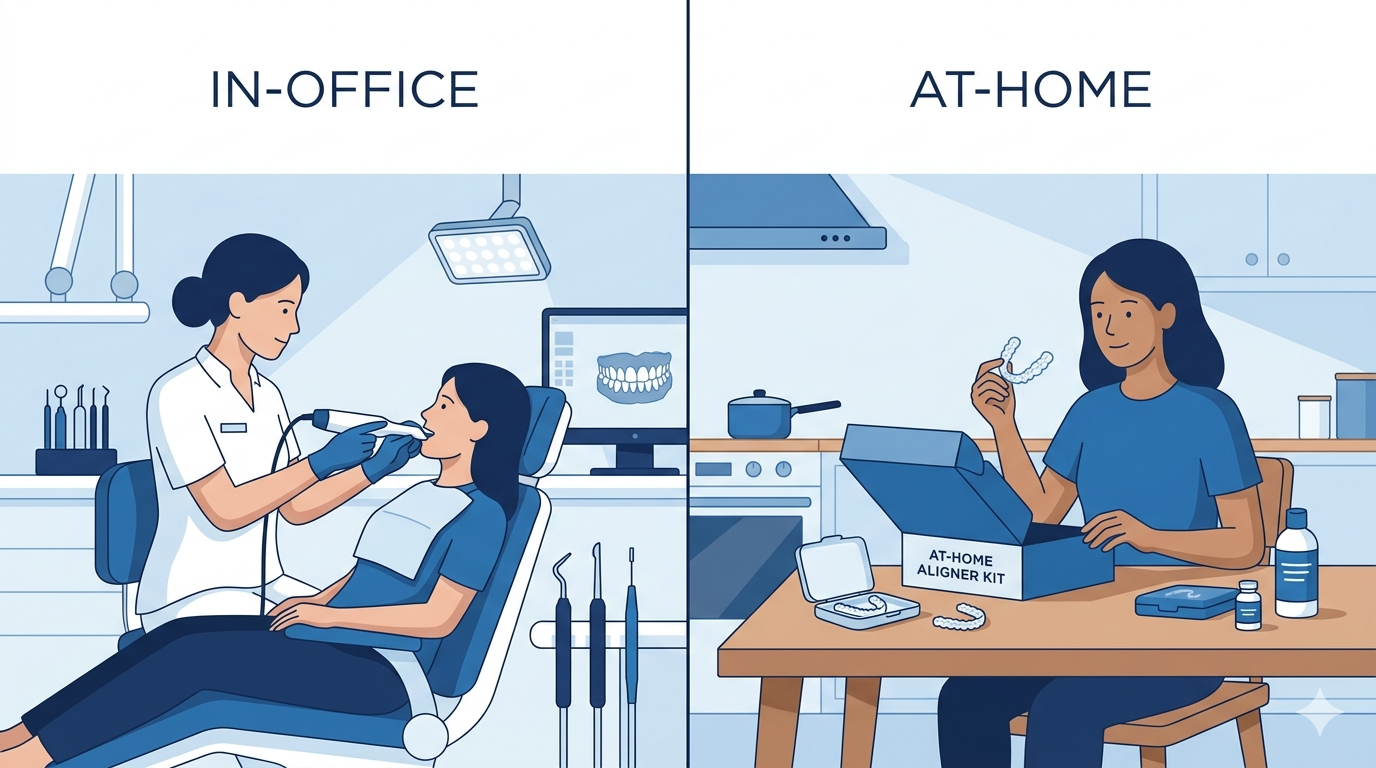
In-office aligners are diagnosed, planned, and monitored in person by a dentist or orthodontist. At-home (direct-to-consumer) aligners are ordered remotely from a self-taken impression or scan, with a licensed professional reviewing your case and progress from a distance.
|
|
In-office aligners |
At-home aligners |
|
Examples |
Invisalign, ClearCorrect, Spark |
Byte, NewSmile, AlignerCo, Smileie |
|
Diagnosis |
In-person exam + X-rays/3D scan |
Self-taken impression or photo kit |
|
Supervision |
Regular in-person visits (~every 6–8 weeks) |
Remote monitoring via app/photos |
|
Attachments & IPR |
Yes |
No (limited) |
|
Typical cost |
$3,000–$8,000 |
$1,000–$2,500 |
|
Best for |
Complex cases |
Mild–moderate cases |
How each one actually works
In-office. Your dentist or orthodontist takes a digital or physical impression in the chair, then a clinical team builds a custom plan. The lab 3D-prints your trays, you switch to a new set every week or two, and you return for follow-up visits roughly every other month. They can bond attachments (small tooth-coloured bumps that grip the tray) and perform interproximal reduction (IPR) — tools complex movements often require.
At-home. You take an impression yourself with a mailed kit, or get a 3D scan, and a series of aligners is fabricated and shipped to you. Some companies connect you with an orthodontist who monitors progress remotely through a telehealth app. There are no in-person visits — the convenience that makes the model appealing is also where its limits come from.
Where at-home aligners shine
They’re genuinely good for the right case. The savings come from cutting per-visit overhead, not the trays’ quality — reputable brands use the same BPA-free, FDA-cleared plastic and licensed oversight. At-home is a strong fit when you have:
For these cases, multiple systematic reviews have found clear aligners produce outcomes clinically equivalent to braces — so a well-run at-home plan can deliver the same result for far less.
Where in-office is worth the premium:In-Office vs. At-Home Clear Aligners
The case for in-office isn’t the trays — it’s the diagnosis and the steering. Every major dental body, including the AAO and ADA, recommends a full in-person diagnostic workup before starting any orthodontic treatment. Book an in-office consult if you have:
Without a clinical workup, underlying problems — cavities, gum disease, a skeletal discrepancy — can be missed, and it’s possible to start moving teeth while unknowingly having a contraindication. Moving teeth over an undiagnosed problem can make it worse.
The real decision: it’s about your case, not the brand
The framing “in-office vs. at-home” is slightly misleading. The honest question is: does my case need hands-on supervision, or not?
There’s also a middle path: hybrid models (such as Candid) start you with a professional in-person appointment, then monitor remotely — a reasonable compromise for moderate cases.
How to choose a safe at-home provider (if you go that route)
One caution: night-only aligners (worn ~10 hours instead of 20–22) raise additional questions about predictability, so weigh that convenience carefully.
Frequently asked questions
Are at-home aligners safe?
For mild-to-moderate cases in a healthy mouth, yes — when there’s genuine licensed oversight. The main risk is starting without an in-person exam that would catch contraindications, so a baseline dental check is wise.
Do at-home aligners work as well as in-office?
For simple cases, research shows equivalent results. For complex movements needing attachments, IPR, or bite correction, in-office care is more predictable.
Why are at-home aligners so much cheaper?
They cut the per-visit office overhead, not the trays. The trade-off is the absence of in-person diagnosis and hands-on adjustment.
Can at-home aligners fix an overbite or crossbite?
Generally no — significant bite problems need in-person evaluation and usually attachments or IPR. See an orthodontist.
Should I see a dentist before ordering aligners online?
Ideally yes. A quick in-person exam confirms candidacy and rules out issues that remote photos can miss.
Sources & further reading
This article is for general information only and is not a substitute for professional dental advice. Suitability depends on your individual case. Consult a licensed dentist or orthodontist before starting any orthodontic treatment.