Orthodontic Excellence: Key Insights for Modern Practice
Modern Orthodontics Explained: Tooth Transplants, Anchorage Screws, Material Safety & Complex Cases
Modern Orthodontics Explained: Tooth Transplants, Anchorage Screws, Material Safety & Complex Cases
Meta description: A clear, friendly guide to some of the more advanced corners of orthodontics — moving your own tooth to a new spot, tiny anchorage screws, what BPA really means for dental materials, and how complex jaw cases are planned.
Orthodontics has come a long way. Beyond straightening teeth, today’s treatment can relocate one of your own teeth, anchor movements with screws smaller than a grain of rice, and plan complicated jaw corrections in 3D. This guide walks through several of these topics in plain language, with an honest look at what the evidence actually shows.
A quick note: this is general education, not personal advice. Anything here should be checked against what your own orthodontist or surgeon recommends for your situation.
What Makes a Tooth Transplant (Auto-Transplantation) Succeed?
Auto-transplantation means moving one of your own teeth from one spot in your mouth to another — for example, relocating a healthy tooth into a gap left by one that couldn’t be saved. When the right tooth and the right site are matched well, it can be a wonderful biological alternative to an implant, because a transplanted natural tooth keeps its own ligament and can move and feel more naturally.
A few things tend to make the difference between success and failure:
∙ The stage of root growth. Teeth transplanted while the root is still developing (an “open apex”) tend to do best, because the tooth can re-establish its own blood and nerve supply. Fully mature teeth can still be transplanted, but usually need a root canal afterward.
∙ Gentle, quick handling. The delicate cells on the root surface (the periodontal ligament) are what allow the tooth to reattach. Keeping the time outside the mouth short and handling the root carefully protects those cells.
∙ Light, flexible stabilization. The tooth is usually held in place loosely for a short period so it can heal while still allowing tiny natural movement, which encourages a healthy ligament rather than fusion to the bone.
∙ Timely root canal when needed. For mature (closed-apex) teeth, a planned root canal soon after transplantation helps prevent the root from being reabsorbed.
The takeaway for patients: success isn’t luck. It comes from careful case selection and a skilled, gentle surgical technique.
Working With Anxious or Hesitant Patients
Not everyone sails through orthodontic treatment, and good practices plan for that. A few common situations and how clinicians approach them:
∙ Trouble keeping up with appliances. When wearing elastics or removable appliances on schedule is a struggle, orthodontists often lean on “low-cooperation” options such as fixed self-ligating brackets or small anchorage screws that work regardless of daily effort.
∙ Dental anxiety. Phased introductions, clear explanations, extra appointment time, and — where appropriate — sedation can make treatment far more comfortable. Feeling in control and informed is half the battle.
∙ Oral hygiene struggles. Reminder apps, monitoring tools, and a tighter recall schedule help keep brushing on track and reduce the risk of white spots and decay during treatment.
The thread running through all of these is communication. The more a treatment plan fits your real life, the better it tends to go.
BPA in Dental Materials: What’s Actually Known
BPA (bisphenol A) is an industrial chemical found in some plastics and in trace amounts in certain dental resins and sealants. It’s a hormone-mimicking (“endocrine-disrupting”) compound, which is why it gets attention.
Here’s the honest, current picture — including a real disagreement between regulators:
∙ In 2023, the European Food Safety Authority (EFSA) dramatically lowered its safety threshold for BPA — its tolerable daily intake dropped to 0.2 nanograms per kilogram of body weight per day, about 20,000 times lower than the previous limit of 4 micrograms/kg/day set in 2015. EFSA concluded that typical dietary exposure now exceeds this very low threshold.
∙ Not everyone agrees. Germany’s risk-assessment body (BfR) disputed EFSA’s approach and set a much higher figure, and the US FDA still regards current BPA levels in foods as safe. So this is an area of genuine scientific and regulatory debate, not a settled verdict.
What does this mean for your braces or aligners? In dentistry, BPA exposure from dental materials is generally very small and brief, and BPA-free materials are increasingly available. If it’s something you’re concerned about, it’s a perfectly reasonable thing to raise with your orthodontist, who can talk through the materials they use.
(One unit-of-measurement note for the curious: the EFSA figure is in nanograms — billionths of a gram — not micrograms. The difference is a thousand-fold, and it matters when comparing numbers online.)
Temporary Anchorage Devices (TADs): Tiny Screws, Big Help
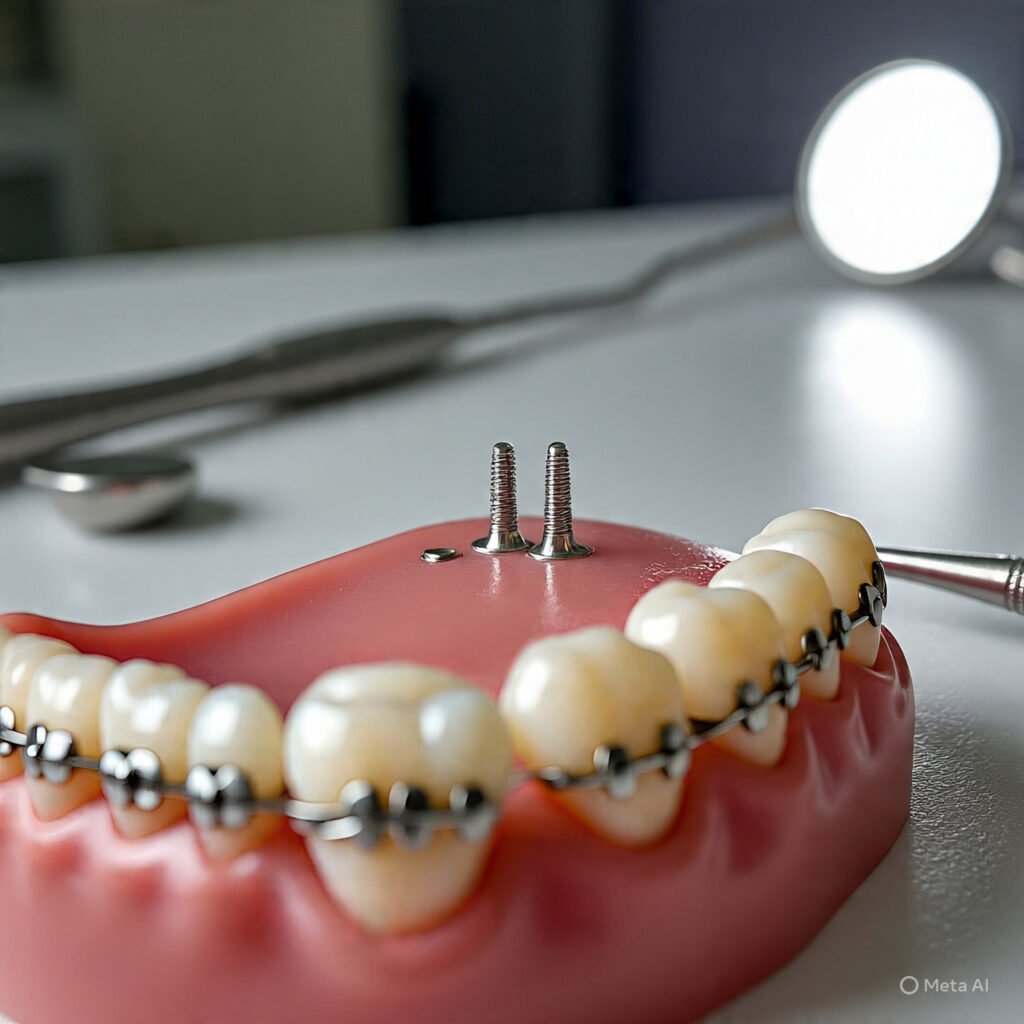
A TAD, or mini-screw, is a very small titanium screw placed in the bone to act as a fixed anchor. It gives the orthodontist a stable point to push or pull against, then it’s removed once its job is done. Patients tend to like them because:
∙ They don’t depend on daily cooperation the way elastics do.
∙ They’re generally less involved and less costly than a conventional dental implant.
∙ They make difficult movements possible — intruding (pushing in) over-erupted teeth, moving molars backward, and correcting asymmetries.
Placement is usually quick and done with local anesthetic, and most patients are surprised by how minor it feels.
Mini-Screw Stability: What Helps Them Hold
Most mini-screws succeed, but a few don’t, and knowing why helps clinicians place them well.
What raises the risk of a mini-screw loosening
∙ Thin or unattached gum tissue at the site. This is the opposite of a common myth: screws placed in firm, attached (keratinized) gum do better, while thin or movable mucosa raises the risk of inflammation and failure. Thicker attached tissue is protective, not harmful.
∙ Lower jaw placement, in some cases. The denser, thicker bone of the lower jaw can mean more heat during placement and more irritation, and several reviews report somewhat higher failure rates there than in the upper jaw.
∙ Contact with a tooth root. Bumping a root during placement is one of the strongest predictors of failure, which is why careful planning matters.
∙ Too much force, too soon, or poor hygiene around the screw.
If a screw doesn’t take
It’s not a big setback. Typically the clinician will remove it, let the area heal for a couple of months, and re-place it — often at a slightly different site, sometimes with imaging (CBCT) to find the best bone.
Why the palate is a favorite site
Screws placed in the mid-palate (the roof of the mouth) tend to be among the most reliable, with notably lower failure rates than cheek-side sites between tooth roots. The palate offers good bone and is away from muscle pull and tooth roots — which is exactly why orthodontists often choose it for demanding cases.
Planning a Complex Case: Open Bite With Jaw-Joint Changes
Some of the most involved cases combine several problems at once. Consider a patient with an anterior open bite (front teeth not meeting), a gummy smile, an underbite tendency, and changes in the jaw joints — a condition sometimes called idiopathic condylar resorption, where the top of the lower jawbone gradually remodels and changes the bite over time.
These cases are handled as a carefully staged team effort, usually something like:
1. Stabilize the jaw joints first. Imaging (often MRI) assesses the joints, and the bite is supported and the joints are confirmed stable before anything permanent is done — because operating on a still-changing joint risks the result shifting later.
2. Prepare the teeth (pre-surgical orthodontics). The teeth are aligned and positioned so the jaws will fit correctly after surgery, including managing the vertical height of the back teeth.
3. Corrective jaw surgery. Once stable, the surgeon repositions the upper and/or lower jaw to close the open bite, reduce gummy display, and balance the face. The exact procedure depends entirely on the individual’s anatomy.
4. Retention and fine-tuning. Retainers hold the result, and additional measures are added only as needed.
The reassuring point for patients facing something like this: it looks daunting written out, but it’s a well-trodden, methodical pathway, and the staging exists precisely to make the outcome stable and predictable.
The Bottom Line
Modern orthodontics weaves together biology (moving your own teeth), thoughtful patient care, material awareness, clever biomechanics (those tiny screws), and careful team planning for complex cases. The common theme is that good outcomes come from sound technique, honest information, and a plan built around you — not from any single gadget or shortcut.
If any of these topics touched on something you’re dealing with, the best next step is a conversation with a qualified orthodontist who can look at your specific situation.
This article is for general education and is not a substitute for professional dental or medical advice. Regulatory positions on substances like BPA differ between agencies and continue to evolve; figures cited reflect named bodies (EFSA, FDA) as of the dates given. Always consult a qualified clinician about your own care.
Suggested keywords: tooth auto-transplantation, biological tooth replacement, managing dental anxiety orthodontics, BPA dental materials safety, BPA-free braces, temporary anchorage devices, orthodontic mini-screws, mini-screw failure causes, mid-palatal TAD, complex jaw surgery orthodontics, anterior open bite treatment