How Much Do Clear Aligners Cost in the USA? (2026 Patient Guide)
Aligners cost yes If you’ve started researching clear aligners, you’ve probably noticed the prices are all over the place. One site says under $1,000. Another quotes $8,000. Some advertise low monthly payments and never mention the total. The confusion isn’t really about whether aligners work — it’s about understanding what the numbers actually mean.
This guide breaks down what clear aligners cost in the United States in 2026, what drives the price up or down, and how to read a quote so you don’t get surprised later.
The short answer:aligners cost
Clear aligner treatment in the US generally runs $1,500 to $8,000, with a national average around $5,100 before insurance. Where you land in that range depends almost entirely on one thing: whether you’re treated at home (remotely, by mail) or in office (in person, by an orthodontist).
|
Treatment model |
Typical 2026 price range |
Best suited for |
|
At-home (direct-to-consumer) |
$1,000 – $2,500 |
Mild to moderate crowding, gaps, minor front-tooth issues |
|
In-office (Invisalign, ClearCorrect, Spark, etc.) |
$3,000 – $8,000 |
Complex bites, rotations, overbite/underbite, full-arch correction |
Neither is “the cheap option” or “the good option.” They treat different kinds of cases. Paying $6,000 for a problem an at-home tray could fix is overpaying — and paying $1,400 for a complex bite that needs hands-on supervision usually means a poor result and more money later.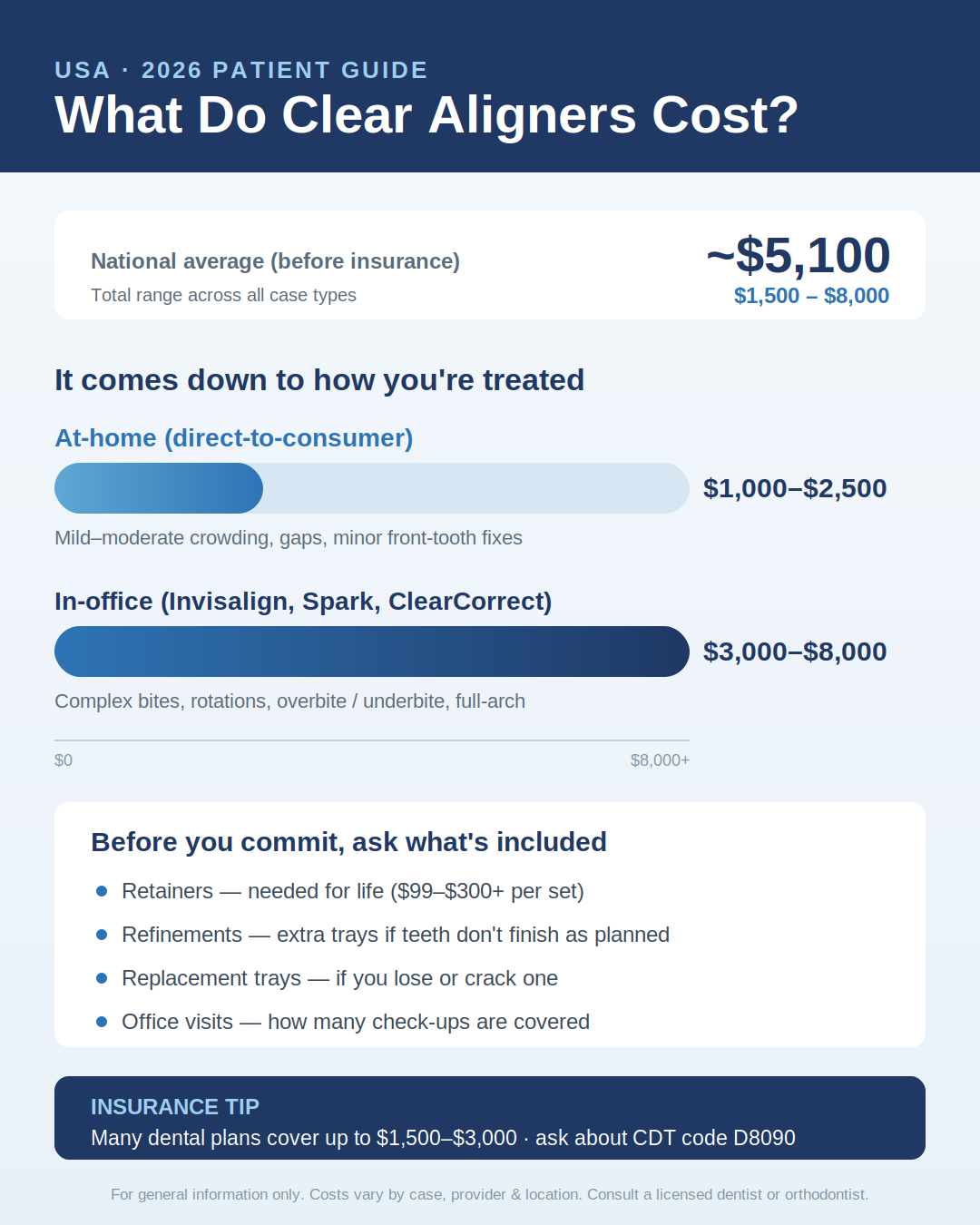
Why the price range is so wide:aligners cost
Five factors explain almost the entire spread:
1. Case complexity. This is the biggest driver. Simple cases may need only 5–10 trays over 3–6 months. Severe cases can need 30–60+ trays over 18–24 months. More movement means more aligners, more time, and a higher fee.
2. At-home vs. in-office supervision. At-home brands cut out the in-office overhead — no chairside visits every 6–8 weeks. That’s where most of the savings come from. In-office care includes hands-on bonding of attachments, interproximal reduction (IPR), and in-person refinements when teeth aren’t tracking.
3. Brand. Premium in-office systems like Invisalign and Spark sit at the top of the range. Mid-range and budget at-home brands sit at the bottom.
4. Geography. A case in New York City or Los Angeles can cost thousands more than the identical case in a smaller or rural market — pure overhead and local demand.
5. Provider experience. Board-certified orthodontists typically charge more than general dentists offering aligners on the side. For a complex case, that expertise is usually worth it.
What’s actually included (and what isn’t)
This is where patients get caught out. Two quotes for “$4,000” are not always comparable. Before you commit, get clear written answers on:
A slightly higher all-inclusive quote often beats a lower one that nickel-and-dimes you on retainers and refinements.
How insurance and tax-free dollars change the math
Many dental PPO plans with orthodontic benefits cover a percentage of clear aligner treatment — often up to $1,500–$3,000 in lifetime orthodontic benefits. Coverage usually applies whether treatment is at-home or in-office, but you have to ask.
Practical steps to lower your out-of-pocket cost:
Clear aligners vs. braces on cost
People often assume aligners are dramatically more expensive than braces. In practice they’re close. In 2026, metal braces typically run $3,000–$7,000, ceramic braces $4,500–$8,500, and lingual braces can exceed $8,000. Clear aligners overlap this range almost exactly — so for most patients, cost alone isn’t the deciding factor between aligners and braces. Suitability and lifestyle are.
How to figure out your cost
A vague online range can’t price your specific mouth. The only way to get a real number is an assessment of your actual teeth:
Either way, the assessment is the cheapest way to replace guesswork with a real number.
Frequently asked questions
What is the cheapest way to get clear aligners?
At-home, direct-to-consumer aligners are the lowest-cost route, often $1,000–$2,000, and work well for mild-to-moderate cases. They’re only appropriate when your case doesn’t need hands-on orthodontic supervision.
Does insurance cover clear aligners?
Many dental plans with orthodontic benefits do, often up to $1,500–$3,000. Coverage typically applies to both at-home and in-office treatment — confirm with your insurer and ask about code D8090.
Are cheaper aligners as good as Invisalign?
For simple cases, budget aligners can produce comparable results at a fraction of the price. For complex bites, in-office systems with an orthodontist remain the clinical standard.
Do I have to pay for retainers separately?
Sometimes. Always confirm whether retainers are included, since you’ll need them for life to keep your results.
Sources & further reading
- This article is for general information only and is not a substitute for professional dental advice. Costs vary by individual case, provider, and location. Consult a licensed dentist or orthodontist for diagnosis and personalized pricing.